The short version
One custom email a month to your past customers, written by a person from a story out of your business. Underneath it, automated flows that fire on every job you close. All of it sends from a Klaviyo account in your name, which you own. Every month you get a report showing what it booked.
Month one is the build
The $3,500 build fee covers this month.
Week one: connect, clean, authenticate. Three things run at once. We connect to ServiceTitan or Housecall Pro MAX and pull your customers, job history, equipment records, and estimates. Without that connection there’s nothing to personalize from, which is why one of those two platforms is required.
At the same time we clean the list. Most contractor databases carry duplicates, dead addresses, typos, and people who moved four years ago. We fix what we can and quarantine what we can’t, because sending to bad addresses is what wrecks a sender reputation, and reputation is slow to earn back.
Also week one, your domain gets authenticated. SPF, DKIM, and DMARC records go into your DNS. If you don’t know who controls your DNS, we’ll find out with you.
Week two: design and write. Templates built in your logo, your colors, your voice. Used all year. We write your first email the same week.
Week three: your automations. We sit down with you and decide what gets built. The flows below are where every account starts, and week three is the conversation about what your business needs on top of them.
Week four: your first email goes out, assuming your DNS access came through and your list didn’t need heavy repair. When one of those slips it’s closer to week six. We’ll tell you which one you’re on after week one.
What a normal month looks like
From your side, two things.
You send us a story. A job that went sideways and came out right. A note from you about where the business is headed. A new tech worth introducing before they show up in somebody’s driveway. The Little League team you sponsored. Those land as well as any job site photo, and sometimes better.
Snap a picture and record a sixty-second voice memo in StorySpark™, right from your phone’s browser. No app, no login.
Some months you won’t have one. We pull a story from the jobs you already closed, using your techs’ notes, photos, and job text.
The year has a shape. We plan your twelve months around your trade’s calendar, not a generic content calendar. Sump pumps before the spring rains and water heaters before the holiday rush. AC tune-ups before the first heat wave, furnace safety checks before the first freeze. Paver sealing in summer, irrigation winterization in fall, snow and ice work in winter for the patio customer who never knew you plow. Panel checks and standby generators before outage season. The trade pages lay out the full year for electricians, HVAC contractors, plumbers, and landscapers.
You review the proof. You get a link to the finished email, fully designed, with a button for every audience going out that month. It’s the real email, not a mock-up. An electrician’s proof can run past twenty buttons: panel upgrade, generator install, EV charger, hot tub wiring, surge protection, smoke and safety devices, commercial work, on down the list, plus the people who got a quote and never booked, the ones who haven’t been seen in a while, and the ones who have never hired you at all. Click a button and the email rewrites itself into that version, subject line included.
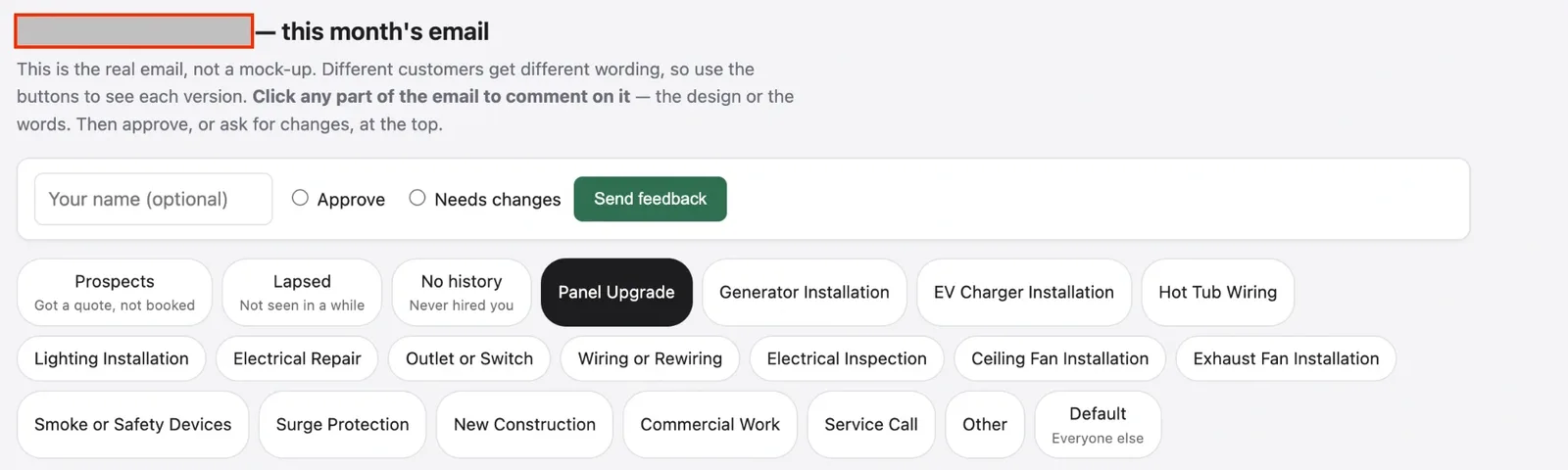
Click any part of the email to leave a note on it, the design or the words. Then approve it, or ask for changes, at the top of the page. Once you’ve approved, we load everything into the system and schedule the send.
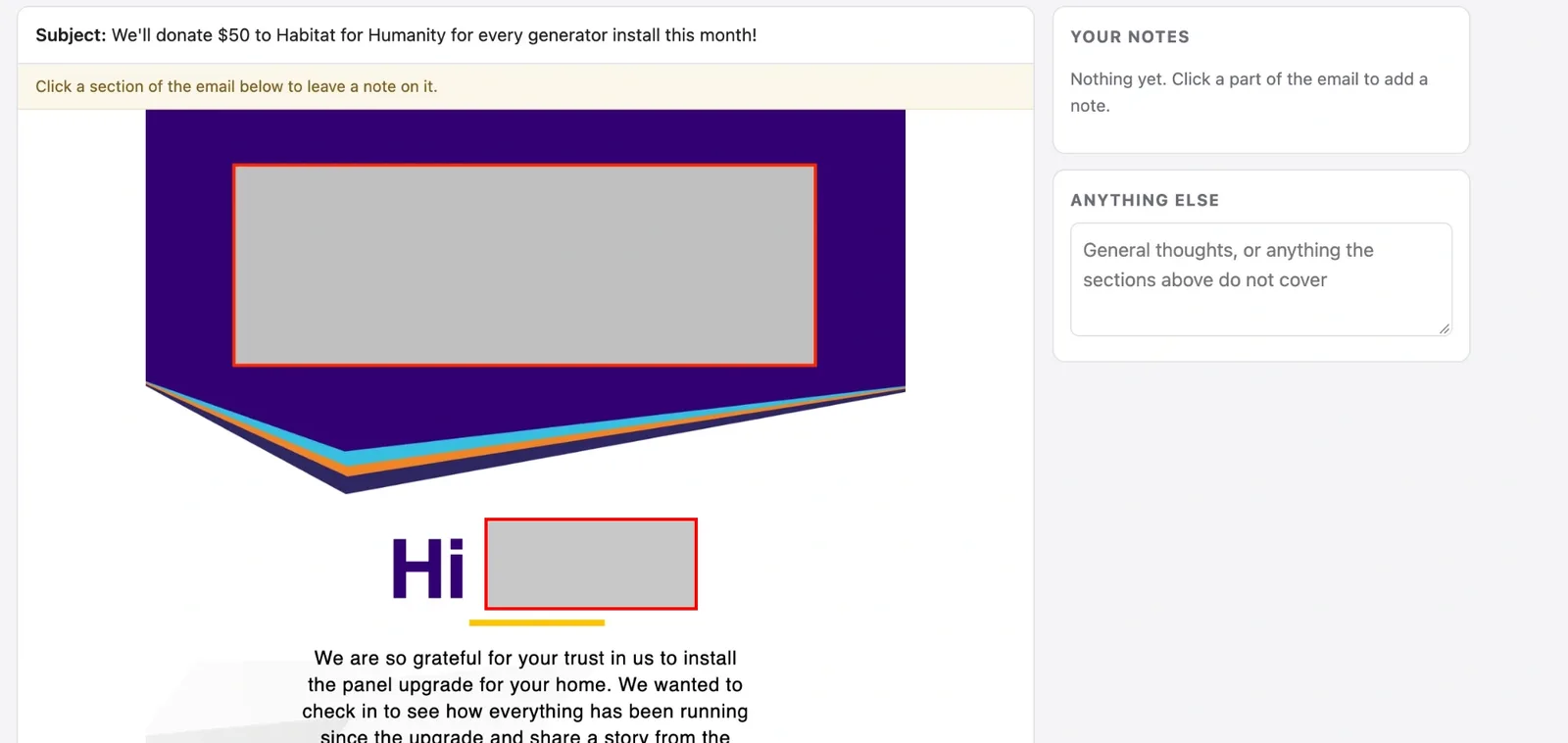
Proof to delivery runs about a week, depending on how many changes come back and how quickly the proof gets looked at. Everything in between is ours: the writing, the design, the personalization, the send, the tracking.
One Cleric owns your account and you have a direct line to them, so you aren’t re-explaining your business to whoever picks up. Once a quarter we step back from the monthly rhythm and look at what’s working and what should change.
The same send, a different email
One campaign goes out. But the customer whose panel you replaced and the customer whose water heater you swapped don’t get the same email. The subject line, the story, and the offer all change based on the work you actually did for them, how long it’s been, and what that customer is worth.
There’s a working demo on the homepage where you can change the job and watch the email change.
The flows running underneath
The monthly email keeps you remembered. These keep you booked. Every one fires off your job data without anyone pushing a button.
Four of these come standard. They’re written here in generic terms so the table stays readable, but each one gets built in your trade’s language:
| When | What goes out | Why it matters |
|---|---|---|
| Within 24 hours of a paid invoice | A one-tap review request, with one polite follow-up if they forget | Reviews without anyone chasing them |
| Day 90 after a big install | A check-in on how it’s holding up | A warranty issue surfaces as a quick fix instead of an angry call |
| Day 365 | A tune-up reminder matched to the equipment you installed | Last year’s customers booking this year’s work |
| 18 months quiet | A reactivation email, different in tone from the rest | Dormant customers brought back before they call someone else |
“Day 90 after a big install” is a note about settling joints on a paver patio, a first-season check on a new condenser, or a load review on a panel with capacity the homeowner isn’t using. Same flow, different email, because it’s built off the job record.
Week three of the build is the working session about what else you need, and the answer looks different for an electrician doing a lot of generator work than for a plumber whose bread and butter is water heaters. If you sell maintenance agreements or memberships, renewal reminders get built here, and that’s usually the first thing an HVAC shop asks about. Seasonal equipment, permit follow-ups, second-phase project quotes. Whatever the pattern is in your business is what gets built.
Estimate follow-up runs here too, including sold jobs that never got on the schedule.
What you approve, and what you never touch
You approve every email before it goes to a customer. No exceptions, no auto-sends of new content.
You never touch Klaviyo. The account is in your name and you own it, but running it is our job. Nobody is going to hand you a dashboard and a training session.
We also won’t email a customer you just served. Anybody you flag not to contact stays off.
What the report tells you
One page a month, broken out by campaign, in dollars. We follow each booked job back to the email that produced it using your own CRM records, so you can check our arithmetic against your own numbers. Opens and clicks are further down the page.
What you need before we can start
- ServiceTitan or Housecall Pro MAX. Without that data connection there’s nothing to personalize from.
- At least 500 past customers. Below that, the program costs more than the list can return. The $599 trial has no minimum, so start there instead.
- Access to your domain’s DNS, or an introduction to whoever has it.
- About twenty minutes on a call so we know what you sell and what you’d rather not be known for.
What it costs and how the year ends
A one-time build fee of $3,500 covers month one. Months two through twelve are $1,299 each. Year one comes to $17,789. Paid up front, the year is $15,000, which saves you $2,789.
You pay Klaviyo directly, in your own name, usually $30 to $150 a month depending on list size. That one isn’t in our fee, and it’s the only other bill. The automation engine that drives the personalization is ours, and we pay for it. Our fee doesn’t move as your list grows. Klaviyo’s does.
What you need to book to cover it depends entirely on your average ticket. A landscaper at a $9,000 project ticket and a service plumber at $340 are doing very different arithmetic on the same fee. There’s a calculator on the homepage that runs it on your own numbers.
The fee is also flat across all twelve months, and plenty of trades aren’t. If your winter is quieter than your summer, you’ll be paying in January for work that books in April. That’s usually fine, because the off-season is when next spring’s projects get sold and next season’s contracts get signed, but it’s better seen now than in month four.
Around month ten we sit down and look at what the year actually earned. Then we decide together whether to keep going.
You don’t get signed into a second twelve-month term for staying. After the year it runs month to month, renewing on its own until you tell us to stop, so the decision is yours every month instead of once a year.
If you walk at the end of the year, nothing gets switched off and nothing gets taken back. The templates, the flows, the triggers, the cleaned list, and the Klaviyo account are all in your name already. Our Terms say the same thing in writing.
What this program does not do
It doesn’t run your ads, build your website, or manage your Google Business Profile. Whoever handles those keeps handling them, and we stay out of their way.
It doesn’t replace ServiceTitan or Housecall Pro. Your platform stays your system of record.
It doesn’t come with a guarantee. What you get out of it depends on the relationships you built, how long your list sat quiet, and the stories we have to work with. We track everything and show you all of it, including the numbers that don’t flatter us. Anyone promising you a specific dollar return from email is guessing.
And it isn’t a lead generation program. These are people who already paid you once.
Who this is wrong for
A bad fit costs you a year and costs us a reference.
You want jobs this week. Email to a cold list takes time to warm up. With an empty schedule right now, ads will move faster.
Your list is under 500. Run the $599 trial instead and find out what you’ve got.
You won’t approve proofs. The program stalls if nobody looks at the email. It’s five minutes a month, but it has to happen.
You’re not on ServiceTitan or Housecall Pro MAX and you don’t plan to be.
You want to be hands off entirely. We can pull stories from your job data when you’re slammed, but a program that never hears from you produces emails that sound like an agency wrote them.